Want a FREE book? Sign up for my newsletter!

Showing posts with label Guest post. Show all posts

Tuesday, June 14, 2022

Spill the Tea Tuesday: Be Careful with Self-Care


Today, author Christina Sinisi is spilling the tea...


I’m not sure when it started, maybe in the 1960s and 70s with the “Me” Movement, but a big trend for the last few decades has been to “Love Yourself First.” That last is in quotes because I see those words on a billboard every Sunday driving home from church. I have a problem with that statement, even though saying so might cause an uproar.


I know this may be startling, but I want to put the brakes on self-care as the most important thing in our lives. Just a note, while I am a Christian fiction writer for the purposes of this blog, I am a psychologist for my day job. I am a researcher and teacher, not a therapist or clinician, so I won’t be analyzing anyone. 😊  

As a professor, I teach a variety of courses. One of those courses is Positive Psychology. The field of Positive Psychology started, to some degree, as a reaction to the self-esteem movement. Strangely enough, trying to build up everyone’s self-esteem contributed to higher rates of depression. If everyone is wonderful and we’re all supposed to be happy all the time, and I’m not—then something must really be wrong with me. Another contributor to the dramatic increase in depression since the 1950s may be that society doesn’t stigmatize mental illness as much as it used to (and that’s a good thing), but this change only seems to be a small part of the increased levels of depression and anxiety. Somehow, focusing on yourself more seems to make you less happy.

Before I go any further, let me make it clear that I’m not talking about mistreating yourself or neglecting your needs. I am also not encouraging anyone to stay in an abusive or neglectful situation.

On the other hand, I am talking about putting yourself first all the time. I am talking about canceling people and things who “don’t bring you joy.” Those second two can leave you very lonely and self-centered--surprise. 


Selfish. There. I’ve said it. Sometimes, focusing on self-care is the same thing as being selfish. Let’s say your elderly mother is grumpy and whiny. She certainly doesn’t bring you joy when you visit. She’s sick and in and out of the hospital and compares you to your more successful brother whenever she gets a chance. So, you listen to the Dear Abbys of today’s world and stop visiting.

Or, let’s say you’d rather sleep in on a Sunday than go to church. Or hang out by the pool on a summer Saturday instead of babysitting for a friend. Or even just going out for lunch with a sister.

I think I’ve made my point. Yes, take care of yourself. But not always first or even second. Our purpose on this planet is to love God and love others. A society that puts itself first all the time is not effective, and we need community—to survive as individuals and a species.

So, be careful with self-care as the priority in your life. Research actually shows that helping others and getting your mind off yourself lowers depression and increases joy. Giving time and money to charity increases life satisfaction and life expectancy. 

So, care for yourself, yes, but sometimes care for others more. 

A member of American Christian Fiction Writers, CHRISTINA SINISI writes stories about families, both the broken and blessed. Her works include a semi-finalist in the Amazon Breakthrough Novel Award contest and the American Title IV Contest where she appeared in the top ten in the Romantic Times magazine. Her published books include Christmas Confusion, Sweet Summer, Why They Call It Falling, and Christmas on Ocracoke. By day, she is a psychology professor and lives in the LowCountry of South Carolina with her husband, two children and her crazy cat Chessie Mae.

You can find Christina on her website, Facebook, Twitter, Instagram, Goodreads, and Bookbub.


The tea has been spilled! Who's gonna clean it up? 
Drop your thoughts in the comments!


Tuesday, June 7, 2022

Spilling the Tea about "Spill the Tea Tuesday" -- A fun new blog feature


Today, I'm officially launching a new series on my blog that I'm calling "Spill the Tea Tuesday." You're probably wondering what this is and what "spill the tea" means. Well, I'm glad you asked ;-) 


Because I'm surrounded by teenagers, I'm privy to all their slang, and one phrase they always use: "I've got tea." Which means: I've got information / gossip. On the flip side, if they want to know the latest gossip, they'll say: "Spill the tea!" And so, because I write primarily for young adults / teens, I thought, why not run with this idea? And so, Spill the Tea Tuesday was born. 


Every Tuesday, I'll be featuring a new author, blogger, PA, cover artist, editor, etc., who will come here to "spill the tea" about absolutely anything they want--life, love, books, writing, publishing--but absolutely no politics! 


Here's the current line-up:

June 14th -- Christina Sinisi

June 21st -- Kara Leigh Miller

June 28th -- Sharon Rene

July 5th -- Paige Boggs of Electively Paige  PA Services

July 12th -- Delaina Netherland

July 19th -- Kris Riley of Blissful Services

July 26th -- Connie Ann Michael

August 2nd -- Laurie Wood

August 9th -- Rosalie Spielman

August 16th -- Ashby Frost

August 30th -- Courtney Lynn Rose

September 6th -- Leah Dobrinksa

September 20th -- Judith Gonda

November 15th -- Katie O'Connor


More guests are being added daily. If you'd like to schedule a date to Spill the Tea, feel free to leave a comment below or email me directly at: karaleighmiller@gmail.com.

This is meant to be fun and empowering and uplifting for everyone involved. So, I hope you'll join us for all the delicious tea that will be served. It's really gonna slap. (<-- teen slang for: good, cool, awesome!)

Monday, January 11, 2016

{GUEST POST}: Ten Tips for Writing Middle Grade by Jackie Minniti

Today I'm pleased to welcome author Jackie Minniti. Her book, JACQUELINE, is a fantastic, historical middle grade, and so she's going to share her Ten Tips for Writing Middle Grade Fiction.

~ * ~ * ~ * ~

In my former life as a middle school reading teacher, I got an “up close and personal” look at what middle graders like in a book. This came in handy when I decided to pursue a second career as a writer.

My dad, a WWII veteran, only shared one war story with our family – the tale of Jacqueline, a little girl who stole his heart while he was stationed in France. When I started writing, Dad asked me to write a book about her.  Jacqueline was about 11 years-old when she met my father, so I decided to write her story as a middle grade novel.  Since writing for this age group presents some unique challenges, I used what I knew about middle school students to craft a novel that would appeal to even the most reluctant readers. I’d like to share ten middle grade writing tips.

1. DO familiarize yourself with your audience
If it’s been a while since you been around 8 to 12 year old kids, find some and spend time with them. Talk to them about the books they like (and the ones they don’t.) Ask them what makes them choose one book over another, and what genres and topics they’re interested in.

2. DO plunge right into the action
Once they pick up your book, you’ve got one chance to hook them. Your first sentence may that chance. For my book, Jacqueline, I spent more time on the first sentence than on the entire first chapter. I finally came up with this: “Her mother’s scream was followed by the crash of shattering glass.”  My 10-year-old beta reader said it made her want to keep reading, so I knew I had a winner.

3. DO make your protagonist age-appropriate
Your main character will make or break your novel. Middle schoolers like to read about kids a little older than they are, so your protagonist should be between 10 and 13 years old.  Your main character should be someone your readers can identify with and care about; a kid with strong opinions and beliefs. Be sure your character has a few flaws though – middle graders have lived long enough to know there are no perfect children.

4. DO use authentic dialogue
Middle school students like to talk, and they like books with lots of dialogue. Listen to middle grade kids, get the sound of their dialogue into your head so your character will sound realistic. Make sure all your characters don’t sound the same. Steer clear of coarse or vulgar language – remember that your book will have to be pre-approved by parents and teachers (the actual buyers.)

5. DO focus on friends and school
Middle school students are straddling the worlds of childhood and adulthood trying to figure out where they fit in. Their focus is shifting from home and family to school and friends, and your story should reflect this. Keep parents, teachers and other adults in the background, with most of the action centered on the main character’s interaction with the outside world. Keep introspection to a minimum. Middle schoolers don’t do a lot of self-analysis.

6. DO center the story around a problem the main character can solve independently
There should be a single inciting element in the story – something that sets the main character’s life askew. In Jacqueline, it was her father’s plane being shot down by the Germans. The central problem should be one that the protagonist can eventually solve without adult intervention, so keep this in mind when you plot your story.

7. DO edit out anything that doesn’t propel the plot
Be relentless in your editing. Your final word count should fall between 30,000 and 60,000 words. Avoid excess adjectives and adverbs. Eliminate everything that doesn’t move the plot forward, no matter how much you may love the sound of it.  While you should definitely include descriptions and sensory details, make this about 10 percent of the total text.  My students steered clear of thick books, so keep that in mind when you have to cut a favorite paragraph.

8. DO challenge them
Just because your readers are young, there’s no reason to “write down” to them. They can deal with difficult subjects if presented appropriately.  Use language that makes them stretch a bit, but include context clues so they can figure out the meaning of unfamiliar words. I used several French words in Jacqueline, and my beta reader was able to mentally translate them using clues I embedded into the text. (She was very proud of herself!)

9. DO keep the momentum going
Middle graders have no qualms about abandoning a book that gets “boring.” If you want them to make it to the end, you have to keep them flipping pages. Don’t use too many abstract concepts.  Stick to the “Show, don’t tell” rule so that there’s a steady flow of action. Try to end each chapter with a cliffhanger. Don’t let up on them until the last page.

10. DO end on a positive note
Be sure that your ending is positive and satisfying. Middle grade readers don’t react well to open endings. I’ve seen kids throw a book across the room because the ending left them hanging.  In Jacqueline, I decided to end with an epilogue that showed what happened to the characters as grown-ups.  My beta reader really liked that.

Most of all, DO enjoy the process. Middle grade readers can be profoundly influenced by the books they read, and that’s what makes writing for them so much fun,

~ * ~ * ~ * ~

Thanks so much for stopping by and sharing these tips with us, Jackie! Now, tell us a bit about your book :-)

When ten-year-old Jacqueline Falna hears her mother's scream, she is unaware that the axis of her world is about to tilt. Her father's plane has been shot down by German fighters. In the midst of poverty, food shortages, air raids, and the grinding hardship of daily life under Nazi rule, she forms an unlikely alliance with David Bergier, a twelve-year-old Jewish neighbor who poses as her cousin after his family is "relocated" by the Nazis. When Rennes is liberated, Jacqueline meets an American soldier and becomes convinced that he has been sent to reunite her with her father.

Based on a true story, "Jacqueline" is a tale of family, faith, unusual friendships, and the resiliency of the human spirit set against the backdrop of occupied Rennes in 1944. With the drama of fiction and the authenticity of personal history, "Jacqueline" is both a story about family and a family's story.


BUY NOW: Amazon / B&N  


About the Author:

Jackie Minniti was born and raised in the heart of New Jersey. She spent 25 years as a classroom teacher and was an education writer for the Courier Post. After retiring from teaching, she moved to a small beach town on the west coast of Florida and began writing full-time. She is currently a columnist for The Island Reporter in St. Petersburg. Her first novel, Project June Bug, the story of a young teacher's efforts to help a student with ADHD won several awards including Premier Book Awards "Book of the Year." A number of her stories have been included in Chicken Soup for the Soul collections.

Jackie lives on Treasure Island with her husband and two rather noisy macaws, but she frequently travels back to New Jersey to visit her three children and six grandkids.

You can learn more about Jackie and her books by visiting her on her website, blog, and Facebook.


Wednesday, December 16, 2015

{GUEST POST}: How my Writing Process Impacted my Book by Carrie Dalby

Thanks for having me on your site today, Kara. I decided to focus on something that will give your readers insight into many aspects of Fortitude in the shortest period of time: my writing process. I promise not to make it as boring as it sounds.

Fortitude began life after I saw a picture of a goat in a tree. (https://www.pinterest.com/pin/19492210857092970/) Yes, a hooved creature in an oak tree on Dauphin Island was just the odd sort of thing to get my brain thinking about days gone by. It was by no means glamorous, but I had a location and an animal, and everyone knows a goat in a tree is in want of a human to look after it.

Claire O’Farrell’s younger brother, Kevin, was compiled first but Claire didn’t take long to shape. At first I worried about my stories sounding the same because I was fresh off writing a contemporary YA but I realized Claire’s voice was brave and feisty—a much different personality than the main character in my previous work-in-progress.  She stands on her own with conviction, even if she later doubts her choices.

Next I discovered the time period. After all, it’s difficult to write a historical without a certain year in mind. Information on the deplorable conditions U.S. soldiers met as they gathered in Florida for the Spanish-American War gleamed from a couple pages in the middle of a biography I was reading for fun. I was shocked, sickened, and upset that I’d never learned about the Florida camps in all my history classes. I knew it was a cause Claire would get behind, she just needed a catalyst to get her there in 1898.  Enter Loretta.

When I came across a collection of photographs taken by W.E.B. DuBois depicting African-Americans that were assembled for the 1900 World’s Fair in Paris, the portrait of a young woman immediately spoke to me. (http://www.loc.gov/pictures/resource/cph.3c24687/?co=anedub) She was extremely feminine, fashionable, and confident. Who else could pull off a hat like this? (http://www.loc.gov/pictures/resource/cph.3c24686/?co=anedub) While I gathered the images of a few other characters from this amazing portrait collection (see my Pinterest board for more https://www.pinterest.com/wonderwegian/fortitude/), Loretta’s voice was the loudest. “Tell my story and make it great!” And once you read about her, you know most people can’t tell Miss Loretta Davis “No.”

I’m one of those people who cannot start a story unless I have a title and music. I knew Claire wouldn’t give up on her quest to help humanity, so I brainstormed words relating to that. A thesaurus may or may not have been involved, but when I got to FORTITUDE, I knew that was it. As part of my outlining (half of it went to the recycle bin once I was in the thick of the actual writing) I compiled “Fortitude GROOVE”, a playlist in my iTunes hub.  It has over thirteen hours of music but I listened to the “Master and Commander” soundtrack the most, especially during edits. From that musical selection, I created the “Fortitude SOUNDTRACK” for the book after I was done. That only has twelve songs, but it chronologically follows the storyline and emotions of Claire’s journey. The two prominent songs that you need to go listen to right now are “No Stone Unturned” by Europe and “Carry On” by Mitch Malloy. (I prefer live versions of both, but all are excellent.)

To write I need pictures and music. In the old days I filled notebooks with photos clipped from magazines and put a CD on repeat. Currently I use iTunes and Pinterest for most of my visuals, but it all does the same thing—inspire me. I don’t wait for the muse to come, I seek her out in all the shapes and forms inspiration can take place. What do you do to stay motivated and inspired?

ALL ABOUT FORTITUDE:

Growing up with a Creole best friend, sixteen-year-old Claire O’Farrell held little regard for the Jim Crow laws and the consequences of befriending those of a different color. But once she leaves the haven of her home on Dauphin Island, the reality of racial intolerance can no longer be ignored. Though she’s underage, Claire makes the bold decision to serve alongside Loretta, her best friend, in the “colored camp” hospital tents during the Spanish-American War, but her idealistic attitude and choice of working location immediately puts her in danger. Claire gives her heart to a soldier in the camp, only to find herself caught in the racial violence besieging the area. When the intolerant attitudes and stigma follow her home, she clings to her faith to navigate through her social isolation and find the path she was meant to travel.

BUY NOW: Amazon


ABOUT THE AUTHOR:
Born and raised in California, but a resident of Mobile, Alabama since 1996, Carrie Dalby is a homeschooling mom with a love of literature for young adults and children. Some of Carrie’s favorite volunteer hours are with Mobile Writers Guild, SCBWI, and Metro Mobile Reading Council’s Young Author workshops. You can find Carrie anytime on her website: www.carriedalby.com

You can also find her on: Facebook / Twitter / Pinterest


Friday, February 28, 2014

Every Girl Loves a Bad Boy

I'm super excited to welcome the lovely Stacey Nash to the blog today! She's celebrating the release of her debut novel, FORGET ME NOT! Stacey is talking about bad boys in YA and why we love them, sharing an excerpt from her book, and offering an awesome giveaway!!


EVERY GIRL LOVES A BAD BOY:

I read a lot of NA and YA fiction and one thing I’ve noticed in the recent string of books that I’ve read is the love in interests. I think it’s more true of current NA than YA, but there are a heck of a lot of bad boys. And we all—well most of us—love them. Throw a heroine into a story with a bad boy and nine times out of ten she’ll fall for him. Even in the classics.
Heathcliff
Romeo

And I’m no exception. I love a good bad boy and in any story that has more than one male character, I fall for the bad boy every single time. And hard. In real life too – my hubby is a sharp tongued, quick witted biker. Or he was when we met at 19, a million years ago. ;) There’s just something about those that’s so damn irresistible.

What is it that makes a bad boy?
A troubled past.
A tendency to block others out emotionally.
Usually, but not always possession of a quick wit.
A tendency to lean toward undesirable qualities – crime, fighting etc

Readers swoon over bad boys, right…it’s not just me. I’m not the weird one chasing the boy parents really don’t want their daughter to date? Phew. I’m glad you’re all in the boat with me.

So, guess what!?

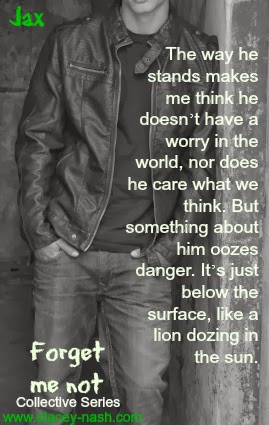
There’s a bad boy hero in Forget Me Not.  He might not be the tattooed broken hero that’s popular in NA right now, but he has a closed off personality which he buries under a thick skin and smart mouth. He’s a bad ass fighter and errs on the side of danger.  

Meet my bad boy, Jax.

<----- 

Blurb: Since her mother vanished nine years ago, Anamae and her father have shared a quiet life. But when Anamae discovers a brooch identical to her mother's favorite pendant, she unknowingly invites a slew of trouble into their world. When the brooch and the pendant are worn together they're no longer pretty pieces of jewelry -- they're part of a highly developed technology capable of cloaking the human form. Triggering the jewelry's power attracts the attention of a secret society determined to confiscate the device -- and silence everyone who is aware of its existence. Anamae knows too much, and now she's Enemy Number One.

She's forced to leave her father behind when she's taken in by a group determined to keep her safe. Here Anamae searches for answers about this hidden world. With her father kidnapped and her own life on the line, Anamae must decide if saving her dad is worth risking her new friends’ lives. No matter what she does, somebody is going to get hurt.

BUY LINKS: Amazon  /  B&N

EXCERPT:
The Collective. That’s what Al said, too. I glance at Will sideways. His mouth hangs slightly open, his eyes wide. He looks as astonished as I feel. Beau’s gaze shifts beyond me, and his face lights up in a smile. When I look over my shoulder, I see Bertie standing in the doorway, waving. She smiles and continues past the room; obviously she and Al are well known around here.
“When tech is used, an alarm is activated, alerting The Collective,” Beau continues. “If the use is unauthorized, they send a scout to appropriate the tech and contain any knowledge of its existence.”
The man in the East Coast Gas uniform, he must have been a scout.
“What do you mean?” Will asks.
Beau rubs his forehead. “Technology, tools, machines, items which perform a specific function. Some tech is common, like cellphones, computers, and satellite tracking, but other tech is not known or used at all. The Collective works hard to keep its knowledge hidden from the general population.”
I shake my head. “I should have known it wasn’t magic.”
The blue flower on the pendant made me appear invisible. Not magic, but technology. My hand still clutches it protectively. How does it work? It has to be some trick with light. I’ve always hated science; I spend most of class daydreaming of being outside with Will and my camera, soaking up his contagious happiness.
Beau’s voice breaks my thoughts. “We also have an alarm. We use it to intercept Collective agents and stop them from harming innocent people. The radar pinpoints the location of the use of tech.”
The boy, the one in the leather jacket. My gaze darts back to the window and the tree branches reaching over the lawn, but I can’t see him. He must have been sent to intercept the gas man.
“This is a safe house. The Collective can’t reach it. You’ll have to stay here while we secure your safety,” Beau says.
“A safe house?” Will asks.
My mind spins again. It’s doing a lot of that this afternoon. There’s so much to take in. This morning we played a dumb game, and now we’re here in the middle of ‘great danger’.
“There are several of them across the country, and each house has a number of people. We will give you assistance.”
My mind whirls. Scouts, collective, safe houses. It’s too much to take in. I move toward an armchair identical to Beau’s, place my hands on its soft, well-worn arms, and sink into it.
“I can’t stay here. My dad, I need to go home to him,” I say. “After Mom, he won’t cope if I disappear, too. He -- he needs me. He doesn’t even have his mother anymore.” I hang my head in my hands, twining my fingers into my hair. He’s balanced so close to the edge of despair, and I won’t push him over.
“They’re relentless. They won’t give up until they find you,” Al says. He’s still here. I’d almost forgotten him. “It’s not safe. You can’t outrun them forever. Don’t worry, I’ll keep an eye on your old man.”
Will’s already rigid stance stiffens further. “What do you mean ‘not safe’?”
“Mae is a threat to the secret knowledge of advanced technology,” Al says, “and The Collective eliminates their threats.”

BUY LINKS: Amazon  /  B&N

About the Author:
Stacey grew up in the Hunter Valley of New South Wales. It is an area nestled between mountains and vineyards. Full of history and culture, it provides wonderful writing inspiration. After dabbling with poetry during her teen years, Stacey stopped writing until after university when she was married with young children. Now she loves nothing more than spending her days with her children and writing when inspiration strikes.

Social Media Links:
a Rafflecopter giveaway

Wednesday, November 6, 2013

{GUEST POST}: The Music Behind Adorned

Author, Georgeann Swiger has stopped by the blog today. She's here to talk about the music that helped to inspire her new book, ADORNED. Welcome, Georgeann! Take it away...

                Like every other writer on Earth, I’ve discovered music is a source of inspiration when I write.  While writing ADORNED, several songs played a big part in helping me create the characters of Micah and Anya.

Anytime I hear Viva la Vida by Coldplay, I picture Micah walking the border been Heaven and Hell keeping evil out of the Kingdom.  Viva la Vida helped inspire Micah’s background as a soldier of the Powers in Heaven.  It also set the tone for his perception that a Powers soldier is superior to not only humans but also guardian angels. The song also made me realize that Micah’s pride would keep him drawn into himself and guarded.


As the story went on and Micah grew and changed, the song in my mind also changed. While listening to Secrets by OneRepublic, I imagined the deeper, darker side of Micah. The sad, melancholy beginning of the song reflects Micah’s true personality. He’s been hurt and made to feel alone during a big part of his existence. Even though he’s not willing to give all his secrets away, they eat at him and leave him seeming cold and brooding.


For Anya, the music that inspired me is just as beautiful and haunting as Micah’s songs. If I Die Young by The Band Perry is Anya’s theme song. The words of the song and the sweet voice of lead singer, Kimberly Perry, is the perfect representation of Anya, a 17 year old who finds out that when she dies she’ll return to her true identity as an angel.  The song sums up Anya’s innocence and her young, romantic heart as she's falling in love with Micah.


Wow, Georgeann, this book sounds darkly romantic. I can't wait to read it. Can you tell us a bit more about it?


Blurb:

When seventeen-year-old Anya finds out she’s actually an angel being trained to protect humanity, she discovers that becoming an angel has nothing to do with wings and haloes. For Anya, becoming an angel has to do with death—her death.

Micah, the angelic soldier ordered to protect her until she transitions from human to angel, promises her death will be a glorious experience as long as she follows his rules. But getting Anya through this life and to the next isn’t as simple as Micah expects. His job becomes even more difficult after he unwittingly performs a miracle that exposes Anya’s hidden angelic light. 

With her secret out, Hell’s legions begin targeting her. Unfortunately, Hell’s minions are the least of Micah’s worries. He’s more concerned about the forbidden human emotions he’s developed toward Anya.  Even more troubling, is she seems to love him too. And giving in to those feelings, could mean dire consequences for them both.
 
You can add this book to your GOODREADS shelf or buy it at the following retailers:
AMAZON  /   B&N   /   KOBO
EXCERPT:

I step onto the back porch, trying to make out what’s going on in the dark. When another flash of lightning reveals three figures clinging together, approaching from the pasture, I yell, “Is that Micah with you?”

Celeste hollers back. “Yes, but he’s not well! Get some towels and a dry blanket!”

I run up the kitchen stairwell and grab three towels from the bathroom and the comforter from my bedroom. I make it back downstairs in time to see Simon and Celeste helping Micah into the house. He leans on their shoulders, shuffling his feet as he staggers through the foyer.

“Dang, you look mangled.” Eli laughs, making it sound like a big joke When Aunt Celeste and Simon lower Micah to the couch in the parlor, he moans as he sinks into the cushions and falls to his side. His bare leg and muddy foot jut out of the wet blanket.

When Simon touches Micah’s forehead, the short uneven breaths Micah sucks through his teeth become even more pronounced.

“You’re burning up,” Simon says. “How could you be so stupid?”

“Give me the towels, darling, and put the blanket down,” Aunt Celeste says. “Shut the door as you leave.”

“I want to know what’s going on. What happened to Micah?” I try to push past her to get to him, but she catches my arm, stopping me.

“Micah will be fine. But he doesn’t have any clothes on,” she says. “You can come in when we get him settled.”

Eli puts his arm around my shoulder and turns me toward the foyer. “Oh, come on beautiful. I’ll wait with you.”

Eli closes the pocket doors and flitters around the foyer like a nosy little dog.

“What happened to Micah?” I ask.

“Oh, don’t worry about him. He’ll be fine.”

“He didn’t look fine.”

Eli’s golden eyes twinkle. “Trust me.”

“Who are you?”

He ignores me and noses around the foyer, putting his fingers all over the glass sculptures.

“Is that Simon guy with social services or the police or something?”

He bends over and blows his hot breath on the crystal ball sitting on a pedestal near the front door. “Something,” he says. When he reaches out to touch the glass orb, a high-pitched scream coming from the parlor makes me freeze in front of the closed doors.

Eli slides past me and puts his back to the doors. “I think they’re done.” He pushes the doors open an inch and peeks inside, allowing a hint of a smoky odor to escape the room. When he opens the doors all the way, I can see Micah slumped on the couch with my comforter around him.

“Is he okay?” I say.

Micah glances at me, then shuts his eyes.

I look at Aunt Celeste. “I want to know what’s going on.”

She fumbles with her pearl necklace and looks away, seeming to fight the urge to run to me.

Eli flutters to her side. “Celeste, you’ve done a fine job. But Micah can take it from here.”

Micah’s eyes pop open. His face turns as white as the daisies on my comforter. 

About the Author

Georgeann Swiger earned her degree in journalism from West Virginia University, and then spent five years as an anchor/reporter at WBOY-TV in Clarksburg, WV.  After having children, she left television news to be a stay at home mom. During that time, she discovered creative writing was more fun than writing about real life tragedy.  Imagining interesting characters and having them come to life on the page is now her passion. When she’s not writing, she works as a substitute teacher.  She lives in Reedsville, West Virginia with her husband, two kids, a beagle dog and a temperamental cat who tries to rule the house.


Don't forget to check out this awesome giveaway!
 
a Rafflecopter giveaway

Sunday, October 13, 2013

{BLOG TOUR}: Finding Home


Please join me in welcoming debut, young adult author, Lauren McKellar to the blog today. She's talking about her newest book, FINDING HOME, and underage drinking.


Underage Drinking: Fantastic Fiction or
Not-Reading-That-Novel?
by
Lauren McKellar

When it comes to writing about anything, you’re making a statement about yourself and your beliefs. Whether it’s a simple, ‘Mom’s potato salad is the best’ line on Facebook (accompanied by a picture of said delicious dish), or something slightly more controversial, it really doesn’t matter. By putting your name next to something in a public forum, you’re forming an opinion—one that could affect the views of other people. And I’m not just talking about the salad they bring to the next family BBQ.

 I released my debut novel two weeks ago, and I knew that, when I did, I was treading on dangerous ground. Finding Home is a Young Adult book, and the major subject matter in this novel is underage drinking.

I have to come clean with you here; I deliberately chose to write about it. This isn’t one of those, ‘Oh, my characters, they made me’ moments. If anything, I opened a bottle of bourbon and I emptied it down my poor heroine’s throat.

The reason I wanted to write about underage drinking is simple; in Australia, the legal drinking age is eighteen. Personally, I had my first drink at around thirteen.

Did I like it?

No.

Did I do it again?

Four years later, sure I did.

Were all my friends like me?

Hell, no! I was very straight, being a book-loving, writing-obsessed nerd. I didn’t know anyone who didn’t go out on the weekends to various parties and get “on the piss” (is that Aussie enough for you?) from the age of around fifteen. And I went to a selective school for apparently “smart” children—you’d think we’d be too busy working out the chemical compound in a glass of beer than drinking it.

And so, when I decided to write YA, I wanted to write something that was real. I didn’t want a book about someone who was innocent and shiny and perfect; I wanted my lead character, Amy, to be broken and to have some very real flaws. Because I met a few Amy’s as a teen. And I lost a few Amy’s, too.

Yes, my book deals with alcohol abuse. It’s a sensitive topic, and not one that everyone wants to read about. I’ve had a few people say it’s even unrealistic, that the parents of these teenagers don’t notice or curb their kid’s booze intake.

I don’t like to get involved in the real vs. unreal debates, no matter which fictional book I’m talking about (because it’s fiction…). What I don’t mind taking a stand on is underage drinking.

People do it.

I don’t know that it will ever change.

But, with awareness and education, hopefully they won’t take it to extremes.

Finding Home has a very clear message on the perils of underage drinking, and one that I hope isn’t too preachy. It’s extremely difficult to walk the line between “moral to the story” and “thou shalt not drink”; and I hope that, by incorporating the voice of reason as another young person and not showing a complete 360 character turnaround, I’ve managed to strike a balance between the two.

For me, if one teenager reads Finding Home, gets into a tough situation, looks at a drink as a solution and thinks “Eh. Not tonight.” Then that’s my mission accomplished. Because that’s the message I’m trying to send, and one I’m happy to put my name to in a public forum.

Now, if you’ll excuse me. I must ask my mother for this potato salad recipe…


ABOUT THE AUTHOR:
Lauren McKellar is a writer and reader of Young and New Adult books. Her debut novel Finding Home is out now, and can be bought from all your usual eBook sites (links available here). She also works as a freelance editor for novels for all age groups and you can chat to her on twitter or facebook any time you’d like. 


ABOUT FINDING HOME:
Moody, atmospheric, and just a little bit punk, Finding Home takes contemporary YA to a new level of grit... 
When Amy’s mum dies, the last thing she expects is to be kicked off her dad’s music tour all the way to her Aunt Lou in a depressing hole of a seaside town. But it’s okay — Amy learned how to cope with the best, and soon finds a hard-drinking, party-loving crowd to help ease the pain.
The only solace is her music class, but even there she can’t seem to keep it together, sabotaging her grade and her one chance at a meaningful relationship. It takes a hard truth from her only friend before Amy realises that she has to come to terms with her past, before she destroys her future.
  
a Rafflecopter giveaway


Wednesday, August 7, 2013

{GUEST POST}: A Day of Writing by J.E. Shannon

I'm happy to have YA author, J.E. Shannon on the blog today. She's talking about what her typical writing day is like. So, take it away, J.E....

On an average morning my day starts much the same way that every mom’s day starts; with my four year old pouncing on my head. Or the dog, sometimes they take turns. This usually happens around six-thirty in the morning. Then I’ll groggily drag myself out of bed, and spend most of the day trying to entertain my four year old daughter. Plus letting the dog in and out...and in...and out. At least one of those times I will open the door, the dog will look at me quizzically, and not move at all. I will tap my foot. The dog will look at my foot, then back at me, but still won’t move. This goes on for at least two minutes before she meanders through the door like royalty. Does anyone else’s dog do that, or is this just payback for the one time I accidentally shut the door on her head? I apologized profusely for that by the way.

            That’s how a normal day goes, but writing days...ah, writing days are special. I still get my head pounced on; I mean it could be Christmas and my head would still get pounced on, so writing days are no exception, but I get to lounge in bed for a little while longer. My husband takes care of the rest. I call this “thinking time” when really I’m usually dozing back off. Shhh....

            Then I’ll run a hot bath. I take a book in there with me, and it’s almost always one of The Hunger Games books. I’m not sure why, but I tend to write better after reading them. It gets my head in the game. Those books are where I want mine to be, so reading them before I go write inspires me to do my best.

            After the bath it’s a flurry of managing the house and getting myself ready. Inevitably, it also includes a search for something. I can ace a game of Harry Potter Trivia without blinking an eye, but for the life of me I can’t remember where I put my keys five minutes ago. Go figure.

            After that I leave the house, with my laptop stowed under my arm. If I tried to write from home I would be interrupted every fifteen seconds, which does not make for productive writing. Sometimes the wrong characters get killed off out of pure frustration. Which maybe isn’t such a bad thing. I mean look how great that works for George R.R. Martin.

            Anyway, nine times out of ten I end up a Panera. In fact the people there know me so well that they usually have my plate and my total waiting for me by time I reach the counter. I’m not sure if that’s really awesome, or really lame. Sometimes I want to tell them, “Oh, I was going to get something different today”, just to mess with them. But I really like those cinnamon bagels, so I never do.

            I know quite a few others also follow my Panera pattern and we usually exchange cheerful greetings. A lot of them are also writers, so we’ll talk about our projects for a little bit. Then I go find my seat. Most times I browse the internet while I eat my apparently predictable bagel. I’ll send a few fun Tweets, or a few funny Facebook messages. By then I’m in a terrific mood. I’ll open up my latest work in progress and then...write a scene where a major character gets half their face blown off. Isn’t being a writer awesome?

            I’ll sit in that place for a couple hours, or however long it takes to reach my word goal; which usually sits in the twenty five hundred range. When I really get into it I’ll have absolutely no idea what’s going on around me. The place could get robbed and I wouldn’t bat an eyelash. Those are my favorite days. When I wrote Awakenings, I could sit for hours and not move an inch. I love the characters in that book so much, even though I made them go through terrible things. I would get so caught up in that world of loss and revenge, new friendships and strong connections; I’d blink and three hours would have passed. It was amazing.

            I love what I do. I can’t imagine a better line of work. I cherish my writing days, but I also love coming home and having my head pounced on. I guess I’m weird like that.

LOL! J.E., this sounds so much like me it's scary. My dogs do that, too, and I have a cat that insists on walking over my lap (where my laptop sits) a dozen times until I make room for her to lay down. Okay, so, tell us about your new book, Awakenings.


 Evie Shepard awakens to a nightmare. She's been buried alive and has no idea how or why. As she struggles to remember what happened, she begins to notice changes -- heightened senses, as well as increased speed, agility, and strength. And her heart no longer beats. She soon makes a disturbing discovery: she wasn't buried alive; she was murdered. Somehow, she has come back...and she wants revenge.

BUY LINKS:  Amazon /  Kobo  /  Barnes & Noble


ABOUT THE AUTHOR:

J. E. Shannon currently lives in Florida, but is a Missouri native. She spends most of her time reading, writing, and taking care of her small child and two crazy dogs. Visit her at www.jeshannonbooks.com. You can also find J.E. on Facebook, Twitter, and her blog.


Giveaway:


To celebrate her new release, JE Shannon is giving away a Kindle with an ecopy of Awakenings (US only). One runner-up will win an ecopy of Awakenings (open internationally). You can enter here: http://bit.ly/13v1u59